In 1855 Gustave Courbet painted a vast allegory of the seven years since the revolutions of 1848. Since The Painter’s Studio’s arrival in the archive, art historians have struggled to place it securely within the canon. This three-part essay argues that the painting’s claims make more sense when read as a work made ‘under siege’, and that our own moment is a timely one from which to read it.
Los Angeles, 2025
In early June 2025, Nadya Tolokonnikova, best known as a founder of Pussy Riot, performed a “durational performance” at the Geffen Contemporary at MOCA, Los Angeles.¹ The work concerned her two-year imprisonment in the Russian penal system. Her strategy was voluntary re-incarceration, within the gallery’s opening hours, in a simulacrum of her prison cell: a disciplinary space reproduced within the similarly exceptional zone of the art museum.
The public watched Tolokonnikova through small viewing windows while she sewed military uniforms, ate kasha porridge and slept. These were clever, paradoxical moves in the game of critical art practice that nested heterotopias inside one another and manufactured complicities. The work was called Police State.
While Tolokonnikova occupied her museum cell, another performance of the disciplinary state was being enacted right outside the Museum. The National Guard and the LAPD occupied the city’s public and civic spaces in support of Immigration and Customs Enforcement. Indeed the museum is spatially close to the Los Angeles federal detention facility where undocumented migrants were (and at the time of writing presumably still are) enduring a captivity that was not performative, and persisted during and outside museum hours. MOCA chose to postpone the rest of the performance, citing the “proximity of The Geffen Contemporary at MOCA to ongoing demonstrations and military activity”.² Tolokonnikova later told the Guardian that the experience was deeply disorientating: she felt she had “entered a wormhole”.³
The idea that critical art strategies like Tolokonnikova’s “compress the space of social relations”, and that raising awareness of oppression is itself an effective politics, has rarely looked more circular. The artist acknowledged as much. “I was thinking of dehumanization and scapegoating as a universal mechanism – applied with heartbreaking ruthlessness both back home and here,” she wrote in an email to the Guardian. “I was thinking how the western idea that history inevitably moves toward progress is a mirage … I think we live in a world that doesn’t really belong to us any more … if 15 years ago, I wanted to radically change the world, now I just want to comfort people.”
Adam Curtis and the return of 1848
This sensation of giddying collapse, of things twisting back on themselves and sincere actions producing perverse outcomes, is a common one at present. In the spaces of “now”, routes to the future appear foreclosed and enemies press too closely for action to be clear.
Just forty-eight hours before the Tolokonnikova interview, the Guardian published a piece by the documentary-maker Adam Curtis, “Thatcher, Farage and toe-sucking”, that identified essentially the same cultural configuration.⁴ It opened: “The mood is very fragile. There is a feeling of global disorder and growing chaos. The threat of war edges ever closer. Some people are even predicting revolution in the UK.” What Curtis said next is worth quoting at length:
“Two years ago, a historian called Christopher Clark wrote a book that makes you look at your own time in a completely different way. Called Revolutionary Spring, it tells the story of the unrest that swept Europe in 1848 … Clark’s book inspired me to make Shifty, my new series of films, because the world he describes feels so similar to today. One in which ‘the political horizon was dark. Neither nations nor governments knew where they were going … Everyone had surrendered to doubt and anxiety. All forms of belief were enfeebled, all forms of authority shaken, social bonds had reached breaking point.’ … All the revolutions failed in their original aim. But out of them came the bourgeois class that was going to run society in the future.”
Returning to 1848 as a reference point for the present was an unexpected move, but it is the one I want to build on. Curtis’s point is that 1848 is useful to think with because participants experienced it as a moment of “no future”: social relations could no longer be predicted from past precedent. Yet the social order that emerged from it went on to shape the world from then until now. Curtis continues:
“Clark showed how from that came all the ways of ordering the world that we today accept as eternal – not just the political structures of left and right but fundamental ideas of our time, like social class. But he is clear that they may be temporary. ‘They belonged to the world that had not yet encountered the great disciplining identities of modern politics. We belong to one in which those identities are swiftly dissolving.’”
Those “disciplining identities” included the ideologies and economic structures of the triumphant bourgeoisie, and also those of its most trenchant critics. Utopianism and the “march of social progress”, universal suffrage, human rights, class struggle, the relation of the individual to the state, personal taxation, consumerism as the basis of identity, and the familiar life course from childhood through salaried work to retirement were all largely forged in, or as a consequence of, 1848.⁵ Try a thought experiment: consider any of these categories as they operated in 1830 and in 1930. The earlier landscape is essentially alien; the later one is largely familiar.
If Clark and Curtis are right that our moment echoes the unknowable future people experienced in 1848, it may be useful, even comforting in Tolokonnikova’s sense, to look at how artists responded to such conditions last time around. That brings me, inevitably, to Gustave Courbet.
The most recalcitrant painting of the nineteenth century
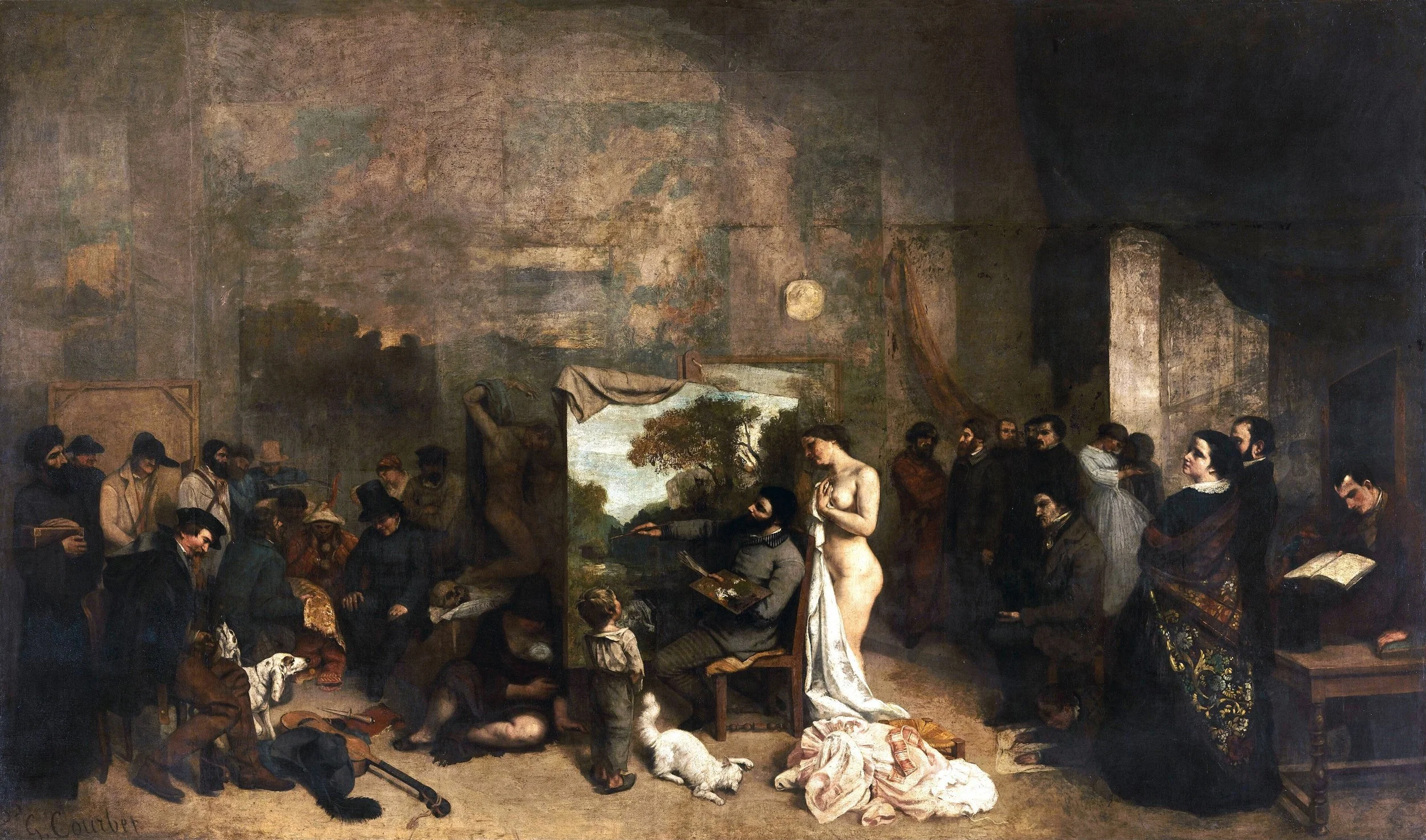
Gustave Courbet, The Painter’s Studio: A Real Allegory Summing Up a Seven-Year Phase of My Artistic Life, 1854–55, oil on canvas, 361 × 598 cm. Musée d’Orsay, Paris. Musée d’Orsay collection record
I want to look again at the most recalcitrant of Courbet’s major paintings, The Painter’s Studio of 1855. The task is simplified because Courbet referred to 1848 in the title itself: L’Atelier du peintre, allégorie réelle déterminant une phase de sept années de ma vie artistique (The Painter’s Studio, a Real Allegory Determining a Phase of Seven Years of my Artistic Life). Those seven years, 1848 to 1855, covered revolution and counter-revolution, precisely the period when Clark asserts that the future was darkest. So could Courbet in 1855 have something to say to Tolokonnikova in 2025, as participants in similar patterns of force and action, albeit from very different positions in time?
The idea becomes more tempting because of the painting’s long history of resisting interpretation. Many of the most renowned art historians of the last seventy years have turned their powerful critical gazes on The Painter’s Studio and come away with only the smallest yields of insight. Neither dense contextualisation nor social-psychological analysis has really reanimated the “grand machine” or given it a contemporary purpose. Most attempts to wrestle this beached whale of a painting into intelligibility invoke exasperation: it is variously “mysterious”, “enigmatic”, “difficult”, “unstable”.
This is not something said of other canonical paintings. Few would call The Raft of the Medusa, A Sunday Afternoon on the Island of La Grande Jatte or Autumn Rhythm resistant in the same way. Rather, The Painter’s Studio belongs to a select and slightly disreputable subset of Western painting: works that are excessive, obtuse, unruly or wilfully hermetic – in a word, recalcitrant in the face of institutional interpretative processes.
Art in a state of siege
A recent book, Joseph Leo Koerner’s Art in a State of Siege (2025), may offer an interpretive standing point that earlier approaches, grounded in the logics of a stable capitalist order, could not.⁶ Koerner’s book specifically examines artists working in moments of political and social breakdown: Hieronymus Bosch, Max Beckmann and William Kentridge, whose 1986 work gives the book its title.
For instance, Koerner describes how Hieronymus Bosch made highly eccentric yet religious paintings, visions of a world abandoned to sin, for powerful Burgundian nobles practised in “urbicide”, the exemplary annihilation of walled cities and their inhabitants. In his paintings cities burn and their foolhardy citizens submit endlessly to judgement and torment. Koerner also argues that Bosch adopted an outsider persona: “Bosch”, meaning “wood” or “woody” in Dutch, signalled an ethical position: the painter as a primitive Green Man or holy fool standing outside and against the artifice and decadence of the city yet aware of his collusive relation to violence. In the 1850s the French press routinely described Gustave Courbet in similar terms: Courbet the graceless, beer-swilling man of the forest, a hunter more at home in the half-wild Jura than in Paris. It is well known that Courbet had fashioned this persona himself to stress his distance from the metropolitan art world.
My argument, developed over this series, is this. Courbet painted The Painter’s Studio from within a siege mentality of the kind that recurs in the Western tradition at moments of crisis. Conceived “antagonistically”, the painting does not use allegory to offer smooth conceptual coherence or to argue for secular salvation. Between 1848 and 1855, the conventional binaries of friend and foe, virtue and vice, the admirable and the detestable, were simply not available to Courbet. Like Tolokonnikova’s carceral performance inside a militarised Los Angeles, his space for action was exceptionally closely constrained.
A garrulous archive
In Revolutionary Spring, Clark points out that the events of 1848 were quickly overwritten by observers who knew they were “living in history” and were quick to settle on superficial interpretations of class and Imperial violence. Likewise, the garrulous archive that has grown around the painting has to be renegotiated with an ‘un-learned’ response that can hold the archive at a distance long enough to perceive the original violence of the painting’s relations.
As an object The Painter’s Studio has had its own journey of visibility and disappearance, latency and crisis. It was shown in 1855 and again in Courbet’s posthumous retrospective at the École des Beaux-Arts in 1882, but otherwise it stayed in private hands until it was bought for the Louvre in 1920.⁷ Since then it has been recruited to every theoretical position: modernist formalism and the “autonomy of art”, Marxist art history, reception theory, psychoanalytic and feminist critique, and the Foucauldian dynamics of knowledge and power. These readings have value; together they constitute a compelling map of institutional insights and blindnesses.
Looking at the picture
The Painter’s Studio is huge, and its material presence awes the viewer. Like Courbet’s A Burial at Ornans (1849–50), the canvas is stitched together from several widths of fabric. Its size and uneven surface, which can never be stretched quite taut, make the image hard to see as a whole; photographs are far easier to read than the unwieldy original. Courbet’s unstable materials, especially a bituminous ground that bubbled and cracked over time, also resist a frictionless encounter. The painting was recently conserved, however, and now looks livelier and more playful than before.⁸ The cleaning has brought out its unusually varied handling. Virtuoso passages give the foreground an arresting, solid naturalism, while the deeper space often remains little more than ambiguously stained canvas.
The pictorial space is as cavernous as the object is large: a vast Hollywood sound stage, apparently extending through portals into murky infinity. These portals may or may not be paintings on the studio wall. There are plenty of these exits, three on the back wall and a single enigmatic arch on the far right.
The studio is thus disconcertingly porous and also unusually crowded, even by the conventions of the ‘homosocial studio’ trope as understood in Romantic nineteenth-century France. Bodies have entered from every direction, and many seem to have organised themselves into constituencies and alliances. Sub-groups attend to each other and to matters of shared concern. Most seem to be waiting for something, some decision or result. Most pay the painter no attention at all.
The composition is clearly tripartite; the venerable Judgement motif, one of a fistful of Christian conventions with which the painter liked to antagonise his correspondents and critics. Courbet sits in the middle, the centre of a knot of bodies and of objects that stand in for bodies, all pressing uncomfortably close to his canvas. His own robust, stylish physicality is pushed so close to the painting that he seems to merge with it, a landscape on which he works confidently and with evident enjoyment.
With a commanding gesture he points his brush at the surface of his canvas-within-the-canvas. For modern viewers that is already a dissonance. We are all iconographers now, and we expect the thing pointed to to be a metonymically legible attribute: saints point to the wounds of their martyrdom, or a wilting flower performs vanitas in a still life. But Courbet points at nothing much, just the edge of a tree in a distant valley. And anyway, why would the promethean Realist artist, seated in this infinite, restless concourse, be tinkering with a rural landscape instead of attending to the invasion of his domain?
On either side of the central knot seem to be two distinct communities. On the left is a baroque collective of costumed men and drifting props: a dog, a guitar, a skull, a dagger. Their clothes suggest stereotypical professional or ethnic identities, some easier to read now than others. The pantomime figure in Chinese costume still registers as a racial stereotype now overlaid with neoliberalism’s ethical unease; but no modern viewer would identify the stolid man in the black stovepipe hat as an undertaker without help from the archive. Their co-presence seems temporary and improvised, inconvenient to them and implausible to us.
On the right things look slightly simpler: a calmer group of men and women in the dress of the 1850s bourgeoisie. There are nuances of difference, but their manners and attention are far more consistent. Their gazes are nominally directed at the painter and his work, yet they too are dispassionate and distracted: reading, lost in thought, looking out at us or lost in each other.
We, like the viewers of 1855, want confirmation that we can read the picture, the reassurance of closure. But meaning is not where we think it should be; even with an archival glossary to assign motives to its cast, The Painter’s Studio reads like allegory in rehearsal.
Next, Part 2: the crises of 1848, the Great Exhibition of 1851, Courbet’s battle with the 1855 Exposition Universelle, and a new source for the painting’s design.
Notes
Wikipedia, “Police State (performance)”; ARTnews interview with Tolokonnikova, June 2025.
MOCA statement, quoted in Rolling Stone Australia.
Lois Beckett, “Pussy Riot’s founder built a ‘police state’ in an LA art gallery. Then the national guard arrived”, The Guardian, 15 June 2025.
Adam Curtis, “Thatcher, Farage and toe-sucking: Adam Curtis on how Britain came to the brink of civil war”, The Guardian, 13 June 2025.
Christopher Clark, Revolutionary Spring: Fighting for a New World 1848–1849 (Allen Lane, 2023).
Joseph Leo Koerner, Art in a State of Siege (Princeton University Press, 2025).
Musée d’Orsay, provenance record; Eugène Chéron’s photographs of the 1882 exhibition, INHA.
